
A Mississippi street preacher gets another shot at challenging a protest ordinance separating him from his audience.
Gabriel Olivier is a Christian evangelical street preacher who thinks you are going to hell, and he isn’t afraid to say so through an amplifier. He will call you a whore and a Jezebel, and tell you that you are a sinner, whether you want to listen to him or not.
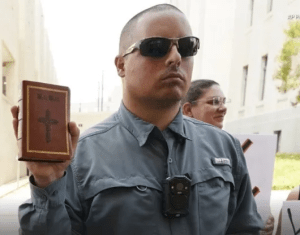
Gabriel took his morality crusade to Brandon, Mississippi, where there is a busy suburban amphitheater (capacity 8,500). He set up on a public sidewalk near the entrance with a loudspeaker and large signs, and conducted his crusade without objection on a number of occasions. In 2019, however, the city enacted an ordinance restricting “groups engaged in protests and/or demonstrations” at the amphitheater to a small, roped off “protest area.” The ordinance also limited the use of amplifiers and large signs, and prohibited “libel, slander and obscenities.”
Gabriel remained in the protest area at first, but he found that being confined to a small area away from pedestrians impaired his ability to preach his evangelical message directly to his audience. So Gabriel decided to defy the ordinance and leave the protest area, whereupon he was arrested and given a municipal court summons. At the subsequent proceeding, he pleaded no contest, and paid the fine imposed by the court.

Gabriel subsequently obtained representation from the Center for Religious Expression,1 which brought a civil suit on his behalf in federal court challenging the ordinance under 18 U.S.C. Sec. 1983 (violation of civil rights). He asked the court to declare the ordinance invalid and enjoin its enforcement in the future.
This is where Gabriel’s case ran straight into a federal procedural swamp.
The federal district court dismissed Gabriel’s case because of the “Heck Bar” which, stated very simply, requires constitutional claims related to a criminal case to be brought in a direct appeal from a conviction. Citing Heck v. Humphrey, the district court ruled that because Gabriel had not raised and exhausted his constitutional claims on a direct appeal from the municipal court, he could not bring them in a subsequent civil suit under Sec. 1983. A federal appeals court affirmed, but the U.S. Supreme Court agreed to hear Gabriel’s subsequent appeal,
Last week, Gabriel’s case yielded a rare moment of complete unanimity in the Supreme Court. All nine justices agreed that the Heck Bar does not apply to a case where the plaintiff is not seeking to overturn his conviction or get money damages for a wrongful conviction. Gabriel is only asking for future relief, in this case, a bar to future enforcement of the ordinance, so the Court ruled that his case may proceed in the lower court.
This is not a decision on the merits of Gabriel’s claim that the ordinance infringes his First Amendment rights. I’m on Gabriel’s side on general principle (although not aligned with his substantive positions), but having dug into the trial court record a bit, I don’t think victory on his part is assured.
Gabriel’s case caught my interest because it raises the issue of a speaker’s proximity his audience. His civil rights complaint details at some length the importance of individual personal confrontation to his evangelical purpose. By way of example from his complaint:
“Olivier also hands out literature expounding on the gospel message. Leafletting is a particularly effective method for Olivier because he can give his information to people as they walk by him.
20. Additionally, Olivier wears expressive clothing bearing religious messages.
21. Olivier especially wants to engage individuals in friendly one-on-one conversations while standing at a comfortable, conversational distance away from them. He believes this method is an effective means to get his message across, allowing for questions and give-and-take verbal exchanges.“
The record in the case below reflects that at least some of the restrictions imposed on Gabriel’s proximity to his audience had to do with safety. Apparently, some concertgoers were walking into the street to avoid being confronted by him. The record also includes videos submitted by the city showing Gabriel in less than peaceful confrontations with some concertgoers, and affidavits from concertgoers alleging that his vitriolic comments made them want to get physical with him.
This is the issue that caught my particular attention due to recent personal experience: how close should a heckler be allowed to get? And how provocative are they allowed to be before they exceed the limits of free speech?
I’ve been at a street corner protest with signs and flags, every week for almost the last year. This particular street corner is situated in a raised area, safely separated from the passing traffic by about thirty feet. There are lots of honks and waves and thumbs up, and an occasional middle finger. Occasionally, people with contrary opinions drop by to express their views, sometimes with polite conversation, and sometimes, not so polite:
This particular gentleman visited the corner recently with not one but two upraised middle fingers. Before leaving the area, he went down the line of peaceful protesters at a distance of about one foot or less from the faces of each and every person, loudly shouting his message with pointed finger emphasis.
How should Ashamed Guy be dealt with? As a matter of personal conduct, my own opinion with respect to obnoxious speakers is that they should be resolutely ignored on basic sandbox principles.
But not everyone who picks up a protest sign on a fine spring day may be mentally prepared for this kind of confrontation, and a person like Ashamed Guy, who is highly motivated to spin up folks if he can, may succeed in provoking a response that will permit him to say that we are not as peaceful as we claim to be. And sometimes, a physical confrontation can erupt by accident, when proximity results in inadvertent physical contact.
Local protest ordinances try to address these types of concerns in a variety of ways, such as designating particular areas for protests and counter-protests, similar to the Mississippi ordinance challenged by Gabriel Olivier. But many of these situations arise ephemerally, where no law enforcement is present, and a call to 911 will not bring authoritative assistance quickly enough to head off a dustup.
In my view, attempting to segregate people like Ashamed Guy is a last resort. As a practical matter, it is up to the cooler heads (which is almost everybody) to model peaceful behavior and help folks who are new to this kind of provocation to put Ashamed Guy and others like him into proper perspective. He came and went, and the protest continued unabated.
We are in a period of time, such as comes and goes in the life of our country, where passions are hot, and the political and social stakes in the next little while are very high. It is all the more important for people who stand for democracy and the rule of law to act with peaceful purpose, and prepare themselves to face down people like Ashamed Guy with equanimity. I would say the same thing to the concertgoers in Mississippi who don’t like being called whores and Jezebels.
I will be interested to know how the lower court will deal with Gabriel Olivier’s case, and how his claimed right to evangelical confrontation will be balanced with the concerns of law enforcement in Brandon, Mississippi. News at Eleven.
 Citizens Resisting Tyranny